
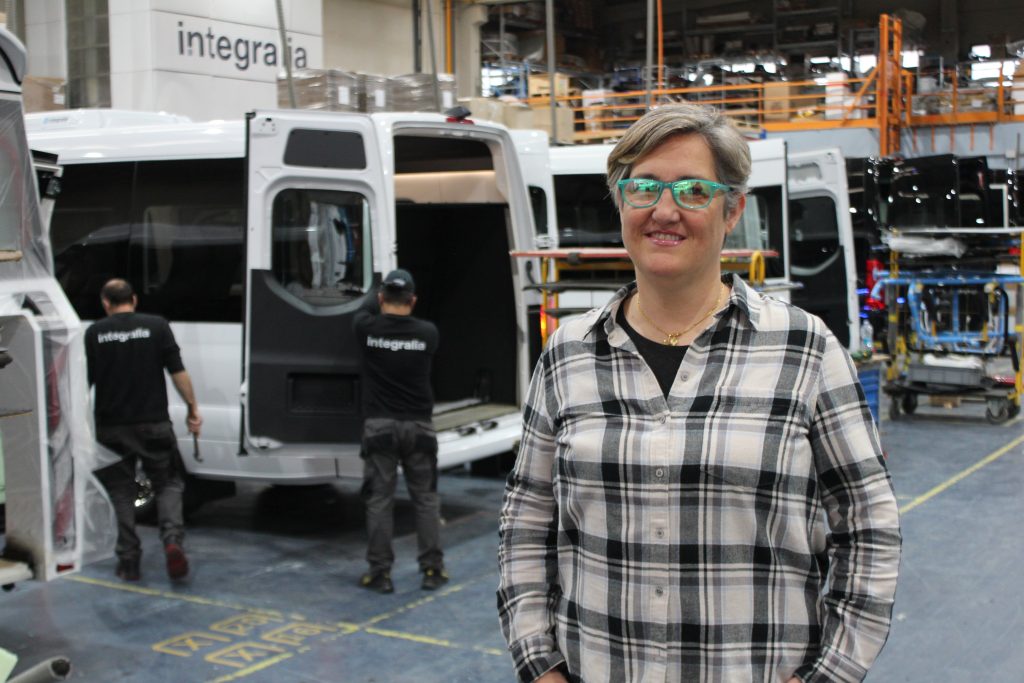
The Director of Integralia’s resource management area tells us about her career and her vision of equality in the world of transport.
What has been your professional evolution over the years, what positions have you held and what have been your main functions in each one?
I started working while I was at university. Business Management and Administration is a career that teaches you a lot of theory, but just studying didn’t motivate me. I needed to prove that the theory was useful in real life, so I started working in an office in the mornings and studying in the afternoons.
Then my brothers started Integralia. In 2002 I joined during my last year of my degree. I started as an administrative assistant and provided support in commercial tasks. In 2009 I did a Master in Financial Management which allowed me to see the company from a different perspective and to be able to participate in its management at another level. Since then I have been the Director of the resource management area.
During the pandemic of 2020 came a time of scarcity of resources and materials, we took the opportunity to change the way we work, so we created the Management Area. A large, but highly interconnected team with the aim of optimising the management and supply of the company’s day-to-day resources: from finance, to material and human resources.
How has the transport world changed since you started your career? What do you see as the biggest developments and challenges in the sector in recent years?
A lot! If we talk about companies, organisations used to be smaller, more personal, today they have become much bigger and management has changed enormously.
About the service: Bus transport was most needed because many people did not have a car. It was an essential service in all towns and cities. Today you have to get the user to choose you from a range of different transport options.
What achievements in your career make you most proud?
I don’t like to focus on milestones. For me, the important thing has been the personal growth that has allowed me to achieve my career. Taking on new projects and seeing them through is what I value most. And the important thing is to keep going despite the many falls along the way.
Have you had any mentors or role models who have influenced your professional development?
My role models are my brothers and my grandmother.
How do you ensure that your leadership inspires and motivates others in your team?
I have never been much of a leader. It is very clear to me that projects cannot be carried out if we don’t work on them together. We have to be little ants.
What have been the biggest challenges you have faced as a woman in a leadership position?
Surely being a woman in a men’s sector is a challenge in itself. Fortunately many of the attitudes I have seen have radically disappeared. We have come a long way.
Do you have a strategy in place to promote gender equality in Integralia
At Integralia we are committed to equality as a matter of principle. There is no strategy. It is our usual way of doing things.
What changes do you think are needed to improve the representation of women in leadership positions?
Mainly education. The inclusion or exclusion of women is in people’s heads, in the education we have been given and in the education we give to our children. And for that, of course, we need the other half of the population: men also have to believe that we are capable.
Any advice for young professional women aspiring to be leaders?
Women have to believe that we are capable of doing anything.
How do you see the future of the transport world, and where are companies in the sector heading?
We live in a time of great uncertainty. It is difficult to know where it is going to go. I think we have to solve the problems that arise in the short term while keeping an eye on the future, be aware of the possibilities, evaluate them and test them. And be prepared for any kind of bump that comes along.