
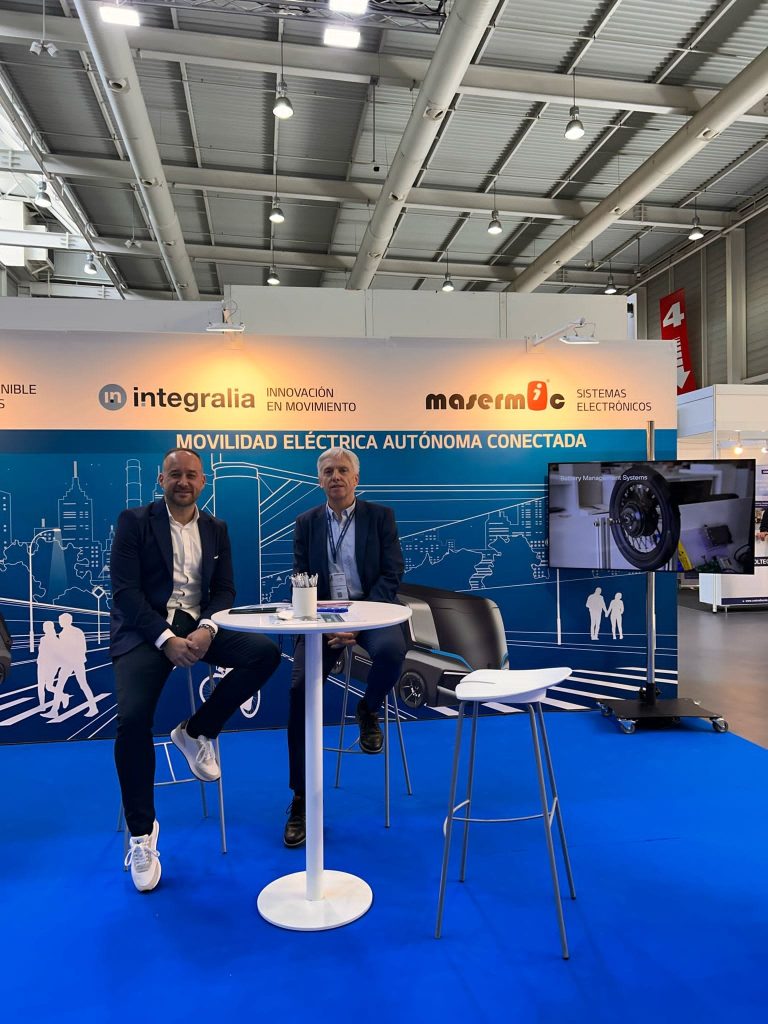
Masermic designs and manufactures electronic systems aimed at the development of smart environments and cities. Since its creation 24 years ago, the Gipuzkoa-based company has been a world leader in the industrial business and services related to the mobility and energy sectors within the framework of Smart Cities, from the engineering process to advanced manufacturing techniques, with a commitment to high quality standards. At the head of the company as CEO, Jesús Iriondo, whom Integralia wanted to consult about his perspective on the future of the sector.
How do you see sustainable mobility?
As a reality in a short period of time, both in urban and non-urban settings. If it were in an enclosed environment there would be no problem, but there are many factors that can be regulated when it comes to inhabited places. At present, the biggest problem is the rules and regulations. At Masermic we are working on draft legislation to make this driving possible with various approvals and certifications. The forecasts indicate that it will be regulated by areas and countries with a near horizon that in five years we will achieve homogenisation. In this case, France stands out, as it currently has the most advanced regularisation. Our neighbours have spaces ranging from E1 to E5, the latter corresponding to vehicles without a driver, and the French are the only ones in the world that currently allow them. Compared to Spain, we still only have E4, i.e. specific areas with an assistant (co-driver or passenger).
And when it comes to energy sources, which perspective is the most realistic?
We believe it can be a mix, from fossil to synthetic, including hydrogen and batteries. Perhaps one of the criteria could be a definition based on geographical areas, with each region having the most suitable one. The future may even be based on the development of vehicles without an energy source and that at the destination each country installs what is most convenient for that place, according to the current regulations and available resources. For example, the clearest case could be hydrogen exclusively for heavier vehicles. Another evidence is that batteries are going to undergo a considerable evolution in the next five years. At the moment, fast chargers (40-50 kW) are causing the battery to lose its life, but significant improvements are already taking place.
In terms of passenger mobility, where do you think the sector is heading?
The objective right now is to make urban transport more frequent and more direct, so it is a strategy of capillary mobility with shuttles playing a major role in urban environments. In other words, minibuses are going to be used to reach a place where the private car is parked, so I believe that the vehicles that are going to win in the market will be those with a capacity of 15/22 seats that, as the most outstanding characteristics, are electric, autonomous and connected. In fact, some cities have already presented their proposals, such as Hamburg. The German city has announced that it plans to install 10,000 shuttles by 2030.
What are you working on at Masermic?
Because of the area in which we are located with a strong presence of the automotive industry, we have been able to realise the real transformation we are facing in a short period of time. It is about us being aware that there is a commitment to develop technologies for the electric market. My prediction is that all this is going to explode within four years at the latest. Right now we are all with the same phrase “we are working on it” and, without a doubt, technology is ahead of regulation. But, that is another point, we must promote this regulatory area from the Public Administrations.
What do you consider to be Integralia’s strong point in facing these challenges?
imminent challenges facing the sector?
Expertise as a bodybuilder, a very strong team and a great knowledge of product certification and homologation, a key issue in the sector. In addition, it is a company with a very important commitment to R+D.